The beauty of research is that every day—well, almost every day—you get an aha moment. There’s never a dull moment. Even when things aren’t working out, you can jump and say, “Wow! We failed again today. There must be something great brewing ahead.” The whole idea of failure becomes so beautiful that it starts to feel like a drug. Let’s fail today, because if we don’t go through enough failures, nothing good is going to come out.
Something beautiful happened today.
Oli—my brilliant long-short brainiac—has been breaking his head for the last 12 months, dedicatedly working on long-short. It’s a business line we’ve been researching since 2010, and one I originally started back in June 2000, in its nascent form. Today, Oli showed me a new aha moment.
Our game is very simple. If you can build a truly smart beta, then you can also build a dumb beta. Then all you have to do is go long smart and short dumb—and that would be the holy grail of investment management. Something you could juice for the rest of your living life. And if done right, you could institutionalize it—so you can juice it for three generations after you. Of course, you can always work with smart money to scale it into a $50B fund—just big enough to be nimble, to enter and exit easily, and yet good enough for pension funds to buy insurance from us.
As you can see, we’re not short of aspirations. We work hard, live and die with our research, and that’s why we don’t worry about hitting a ceiling. There are, of course, Active ETFs too, in case we want to open it up and let smart money participate.
Now, you can imagine—it must be something amazing that got me jumping with this aha moment. Don’t get too excited—we still have work to do to perfect the research. But that doesn’t mean we can’t enjoy the small ahas along the way.
I love my research team. Cip—the brilliant mathematician. Bianca—the fintech strategist. Dan—the dev nerd who reads more books in a week than I do in a year. Flori—the CTO we all serve. And Oli—the man who’s digging deep into the long-short oil well.
Since the problem wasn’t hard enough, and a quarter-century hadn’t tired me out, we decided to make it even more challenging: to build a truly investible long-short strategy. If we’re going to raise a ton of money, we need it to be investible. So let’s make it so good that we don’t even have to bother building the “dumb” side. Let’s just assume the market’s MCAP method is dumb—and short it perpetually.
Now, all we have to do is build a better long-only strategy. One that doesn’t make money after a year—but makes money every quarter. Okay, at least two quarters out of four. Otherwise, it’s no fun. Because we don’t have time—I’m almost ready to retire, and I’m in the biggest rush. So let’s build a strategy that assumes it will manage a lot of money, and work backwards from there.
So we assume the MCAP method is dumb, and shorting standard-and-poor investing methods is the best thing to do. Then we put our exceptional and rich process through stress tests, twisting and turning it to squeeze out every possible bias and edge—until it can deliver at least half the time in a year.
In 12 months, we ran umpteen tests, launched two test versions, and now we’re ready to launch version 3.0. And the aha moment? Even before version 3.0 begins, version 2.0 is already challenging us—“Let’s see if you guys can actually beat me.”
When we build something, we generalize, generalize, and generalize. We don’t want to test on just one market. We want the strategy to work everywhere—equities, commodities, sectors, themes, instruments—everywhere. And so we’re forced to simplify, simplify, simplify.
In version 3.0, we’re planning to build a strategy that doesn’t even enter or exit. It just rebalances. How cool is that?
Anyway, enough suspense. The aha moment for me was this: a long-short strategy, perpetually short XLE—a $40 billion MCAP-based U.S. energy fund run by State Street that holds around 40% of its weight in just two stocks, Chevron and Exxon—versus our exceptional and rich versions of XLE… not only had a small drawdown, it actually outperformed XLE itself, on paper over the test run.
Of course, there are many reasons. One is that XLE is energy equity—tied to a mean-reverting energy commodity. A mean-reverting asset is easier to beat, because it moves up and down cyclically. Even if energy takes off and the asset goes ballistic—say, because Xi and Trump decide to have more fun—the fact that a long-short strategy can juice inefficiencies out at a fraction of the volatility was incredible to see.
Oli is now plugging into everything Bianca is building, which Flori is putting on the assembly line, which our king of long-only Cip has factorally perfected, which Dan is warming up the agents to replicate seamlessly. It’ll be fun to watch it all take the form of a multi-strategy long-short machine.
We’ll keep perfecting it. We’ll keep musing about it. We’re building what modern finance says can’t be done. And we know—from on paper to reality is hard. But for us, even getting this on paper was worth more than a muse.
It was aha!
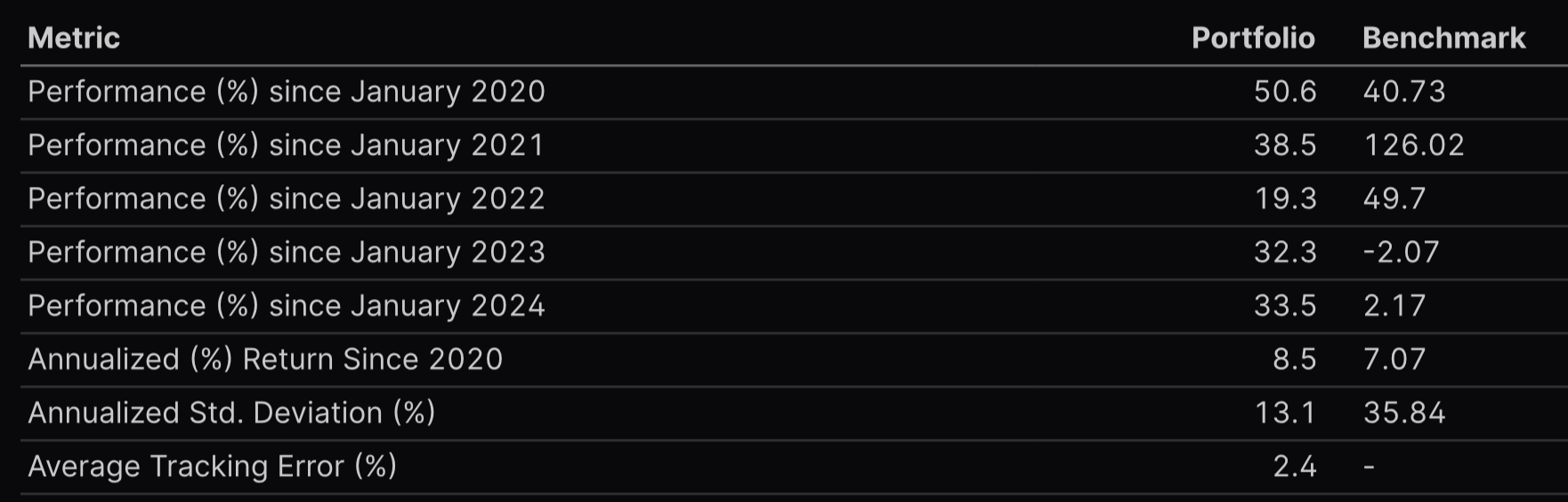

Oh! I forgot to mention, there is no leverage.