Authors: Mukul Pal, Ciprian Tiric, Florina Pal, Bianca Bradea, Oliviu Cigan, Dan Todor
Affiliation: AlphaBlock Technologies Inc.
Date: Nov 15, 2024
Abstract
Market Capitalization (MCAP) is a foundational factor in modern investing, underpinning the design of most index funds and serving as the benchmark for active management in the $100 trillion investment management industry. The perceived superiority of MCAP has been instrumental in shaping the narrative of active managers’ underperformance. This paper introduces the 3N framework as an alternative statistical methodology to analyze and reconstruct indices. Using India’s Sensex as a case study, the research demonstrates that MCAP is not a singular, absolute measure but a composite of statistical behaviors such as mean reversion, divergence, and randomness. By rescoring the Sensex based on the 3N framework, the study highlights the potential for consistent outperformance. These findings challenge the prevailing MCAP-centric paradigm and propose systematic, data-driven approaches for index construction, redefining the active management landscape.
Table of Contents
1. Introduction
-
Literature Review
-
Methodology
3.1 Data Collection
3.2 Statistical Rescoring
3.3 Factor Classification
3.4 Portfolio Construction
3.5 Performance Evaluation
-
Results
-
Discussion
-
Conclusion
-
Bibliography
Introduction
Market Capitalization (MCAP) has long been revered as the cornerstone of modern portfolio theory and index construction. It serves as a proxy for size, liquidity, and perceived market stability, forming the backbone of popular benchmarks such as the S&P 500 and India’s Sensex. The historical narrative of active managers’ underperformance has further solidified MCAP’s dominance as the gold standard. However, the reliance on MCAP has its limitations, particularly its inherent biases, concentration risks, and dependence on winner-takes-all dynamics. This paper revisits MCAP’s role through the lens of the 3N framework, a novel statistical approach that emphasizes dynamic, probabilistic behaviors in financial markets.
The objective of this study is twofold: first, to demonstrate that MCAP is not an isolated, immutable factor but a composite variable influenced by statistical forces such as mean reversion, persistence, and randomness; second, to present the 3N framework as a more nuanced and systematic alternative for index construction. Using the Sensex as a case study, the paper evaluates the implications of applying 3N principles to reweight and restructure the index, offering insights into its potential for superior returns.
Literature Review
The dominance of MCAP as an investment factor is well-documented in academic and industry literature. Its widespread adoption is attributed to its simplicity, scalability, and correlation with market performance. However, several studies have questioned its robustness. Historical critiques have highlighted MCAP’s vulnerability to concentration risk and its propensity to overemphasize winners, thereby amplifying statistical fat tails and ignoring mean-reverting behaviors. More recent research, such as studies on noisy factors and alternative weighting methodologies, suggests that MCAP’s dominance may be more a result of market perception than intrinsic superiority.
The 3N framework, developed in the context of financial markets, addresses these limitations by incorporating statistical principles such as reversion, divergence, and randomness. Previous articulations of the 3N methodology have demonstrated its applicability across various domains, from financial markets to data architecture, highlighting its potential for systematic improvements in asset allocation and index design.
Methodology
To evaluate the effectiveness of the 3N framework, this study applies it to the Sensex, India’s large-cap 30-stock index. The methodology involves the following steps:
Data Collection: MCAP data for the 30 Sensex stocks was collected, assuming a static list since 2009 for consistency and to avoid corporate action adjustments.
Statistical Rescoring: Stocks were rescored using an 8-quarter lookback period. Percentile scores were assigned to measure relative changes, breaking the stocks into quintiles.
Factor Classification: The top quintile was classified as the Statistical Growth Factor, the bottom quintile as the Statistical Value Factor, and the middle three quintiles as the Statistical Core Factor.
Portfolio Construction: Weights were allocated as follows: 40% to the Growth quintile, 20% to the Core quintile, and 40% to the Value quintile. This weighting scheme reflects the dynamic behaviors emphasized by the 3N framework.
Performance Evaluation: The rescored portfolio’s performance was tested over a 10-year period (2014–2024), and extended simulations were conducted on 7,560 portfolios to validate robustness.
Results
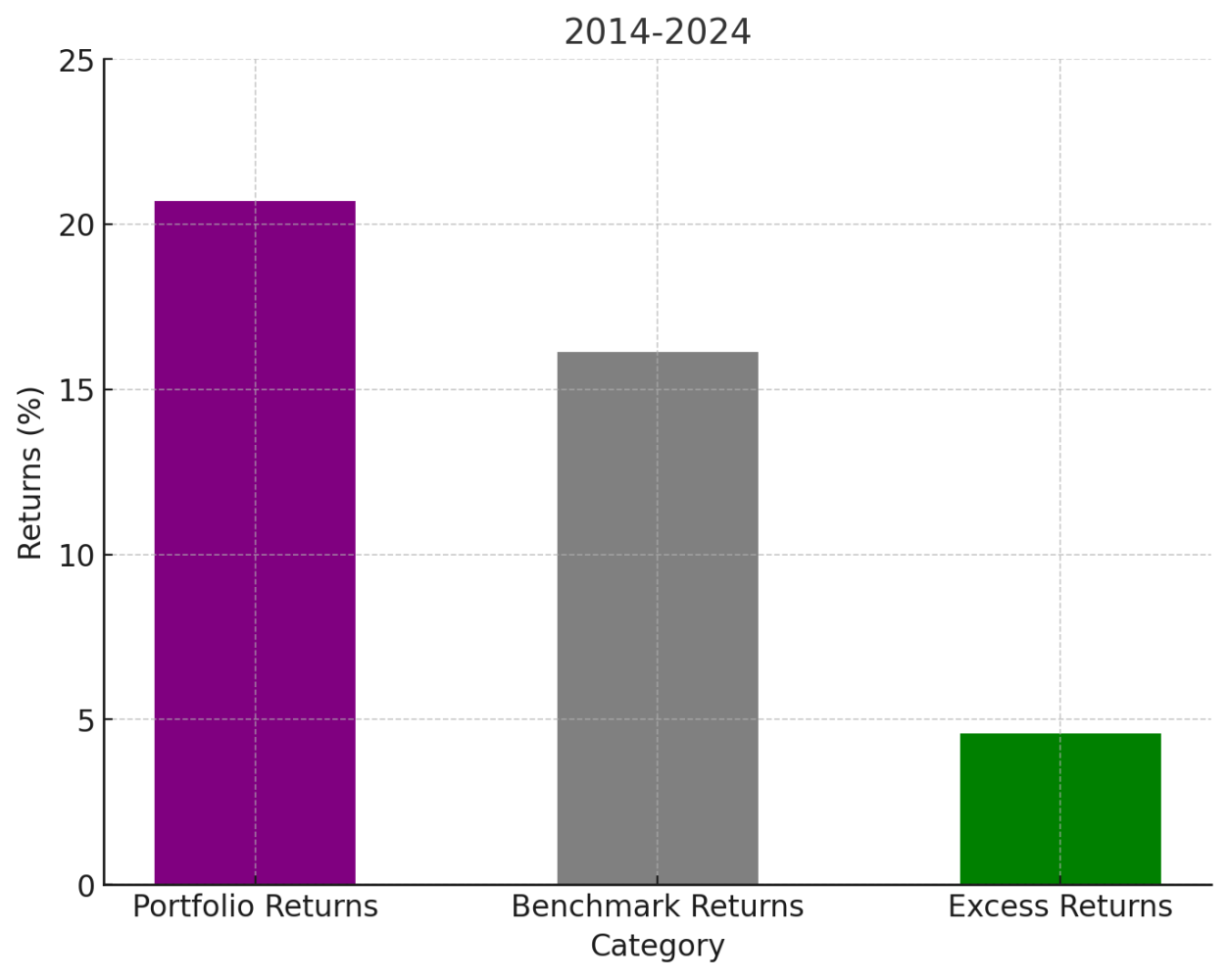
The 3N-rescored Sensex portfolio outperformed its benchmark across multiple dimensions. Key findings include:
Annualized Returns: The portfolio achieved an average annualized return of 20.71%, compared to the benchmark’s 16.13%. This results in an average excess return of 4.57%.
Consistency: The portfolio outperformed the benchmark in 62 of 65 yearly periods, a success rate of 95.38%.
Risk-Adjusted Metrics: The portfolio’s information ratio was 0.90, with a tracking error of 4.98%, highlighting strong risk-adjusted performance.
Volatility and Drawdowns: Average portfolio volatility was 17.34%, with excess volatility of 3.33%. The portfolio demonstrated lower maximum drawdowns compared to the benchmark.
Extended simulations corroborated these findings. Of the 7,560 portfolios generated, 78% produced positive annualized excess returns, with an average excess return exceeding 7%. More than 50% of the portfolios had information ratios above 0.5, emphasizing the reliability of the 3N approach in delivering superior performance.
Discussion
The results challenge the conventional wisdom surrounding MCAP’s dominance. By deconstructing MCAP into statistical sub-factors, the 3N framework reveals its inherent dynamism and susceptibility to mean reversion and divergence. This finding has significant implications for active management. Historically, active managers have struggled to outperform MCAP-weighted benchmarks due to reliance on discretionary decision-making and static methodologies. The 3N framework bridges this gap by providing a systematic, probabilistic approach that enables the transformation of passive indices into active strategies.
Furthermore, the research highlights the limitations of traditional MCAP-centric indices in capturing the full spectrum of market behaviors. By incorporating 3N principles, investors can construct portfolios that are not only more efficient but also better aligned with long-term performance objectives.
Conclusion
This study demonstrates that MCAP, while foundational, is not infallible. Its perceived superiority as an investment factor is rooted in legacy practices rather than intrinsic robustness. The 3N framework offers a compelling relook at MCAP, emphasizing statistical principles to enhance index construction and asset allocation. By rescoring indices like the Sensex, the 3N methodology reveals the potential for systematic outperformance, challenging the MCAP-centric paradigm that has dominated the investment landscape.
Active managers, in particular, stand to benefit from adopting the 3N framework, as it provides the tools to deliver risk-adjusted excess returns and justify their fees. As the investment industry evolves, embracing probabilistic, data-driven methodologies like 3N will be critical for maintaining competitiveness and unlocking new opportunities in portfolio management. This research serves as a call to action for practitioners and academics alike to rethink the role of MCAP and explore alternative frameworks that better reflect the complexities of modern financial markets. MCAP as a variable is no different from any other factor and like every other factor, it itself is a proxy for statistical factors.
Bibliography
Matia, Kaushik, Pal, Mukul, Stanley, H. Eugene, and Salunkay, H. ‘Scale-Dependent Price Fluctuations for the Indian Stock Market.’ EuroPhysics Letters, August 2003.
Pal, Mukul, Shah, M., and Mitroi, A. ‘Temporal Changes in Shiller’s Exuberance Data.’ SSRN, February 2011.
Pal, Mukul. ‘Mean Reversion Framework.’ SSRN, May 2015.
Pal, Mukul. ‘Markov and the Mean Reversion Framework.’ SSRN, May 2015.
Pal, Mukul. ‘Momentum and Reversion.’ SSRN, August 2015.
Pal, Mukul. ‘What is Value.’ SSRN, September 2015.
Pal, Mukul, and Ferent, M. ‘Stock Market Stationarity.’ SSRN, September 2015.
Pal, Mukul. ‘Reversion Diversion Hypothesis.’ SSRN, November 2015.
Pal, Mukul. ‘How Physics Solved Your Wealth Problem.’ SSRN, October 2016.
Pal, Mukul. ‘Human AI.’ SSRN, July 2017. Pal, Mukul. ‘The Size Proxy.’ August 2017.
Pal, Mukul. ‘The Beta Maths.’ SSRN, March 2017.
Maureen, O., and Bhattacharya, A. ‘ETFs and Systematic Risk.’ CFA Research Institute, January 2020.
Pal, Mukul. ‘[3N] Model of Life.’ SSRN, April 2021.
Pal, Mukul. ‘The S&P 500 Myth.’ SSRN, July 2022. Pal, Mukul. ‘The Snowball Effect.’ SSRN, July 2022.
Pal, Mukul. ‘Mechanisms of Psychology.’ SSRN, June 2022.
Pal, Mukul. ‘The [3N] Model of Life.’ SSRN, February 2023.
Pal, Mukul, Fenesi, R., Cigan, O.D., Berciu, A.G., Tiric, R.C., Pal, F., Todor, D., and Dulf, E.H. ‘Revolutionizing Active Investing With Machine Learning.’ SSRN, January 2024.
Pal, Mukul, Tiric, R.C., and Pal, F. ‘Machine Beta, Statistical Factors, Non-Linear Mechanisms And The [3N] Methodology.’ SSRN, January 2024.