Campbell Harvey’s new paper, Passive Aggressive, concedes what many practitioners already feel: cap-weighted index flows push “unrelated stocks [to] move synchronously,” dull price discovery, and heighten liquidity risk. His suggested fix—“rebalancing … to non-price-based anchor weights” such as equal- or fundamentally weighted indices—sounds radical but simply changes the input to the same rule-driven machine.
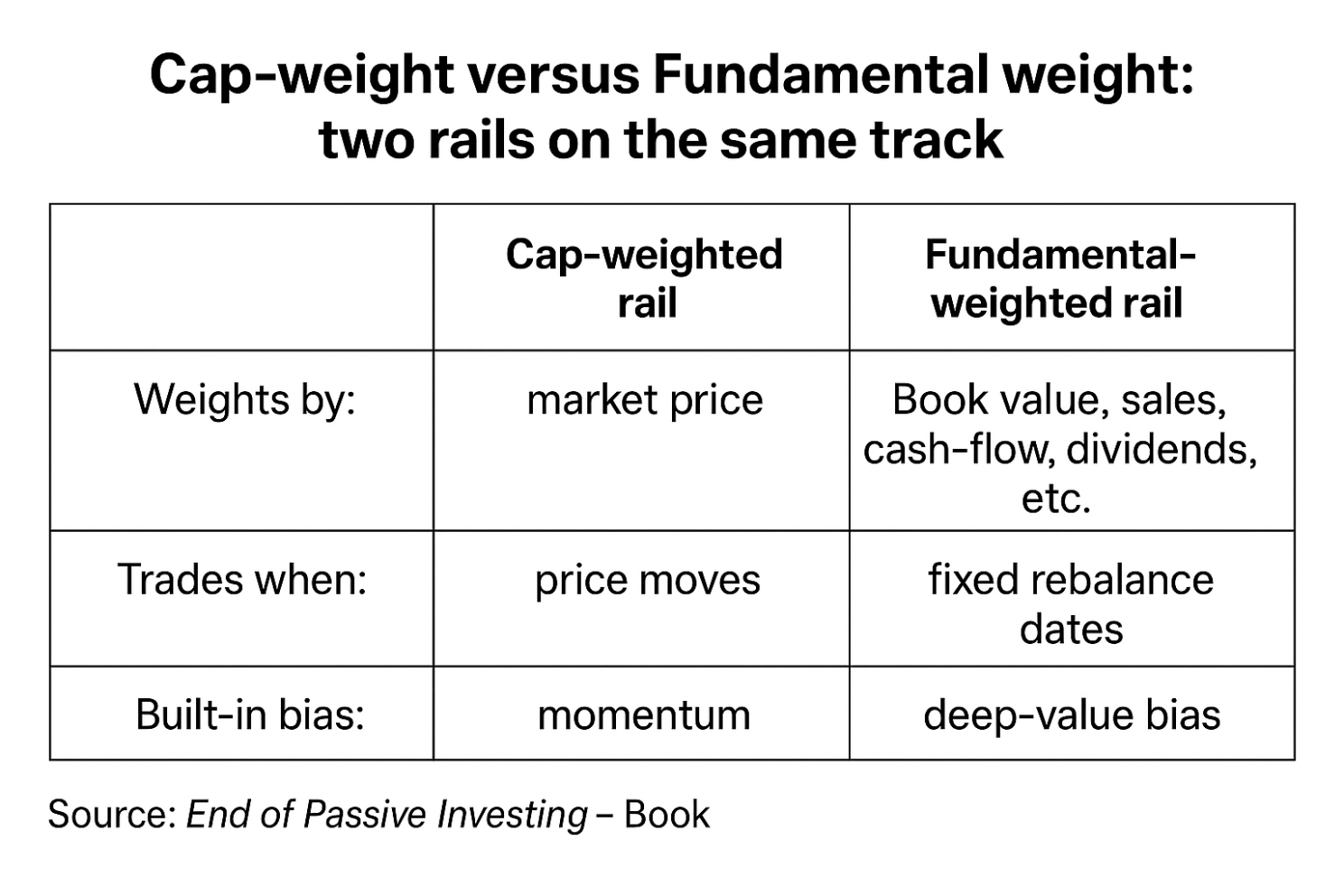
Both rails publish their schedule, inviting arbitrage desks to “surf” the predictable flows—Sammon & Shim show mechanical rebalancing imposes adverse-selection costs on the holders who stick around.
Why the new rail still derails
Value crowding & long droughts. Fundamental-index funds boomed past $100 bn, yet the very value tilt they embed lagged cap-weight for much of 2007-21, exposing investors to a decade-long drawdown . Calendar luck. Performance of any rule that rebalances on a fixed date changes sharply if that date moves even six months—a lottery the rule itself can’t foresee . Still front-runnable. Scheduled reconstitutions broadcast trades days in advance; opportunists earn low-risk spread while long-term holders pay the bill .
Equal- or fundamental-weighting may break the link to price, but it keeps investors no better off than traditional passive: the market is still steered by a blind timetable rather than evolving information.
What End of Passive Investing offers instead
The book shows that every static formula—price, fundamentals, factors—warps prices once it controls trillions, because the rule itself becomes a target . Chapters 8 and 11 recast cap-weight as a Pólya-urn process: each winner draws extra “balls,” making future draws more likely to hit the same name . To stop that feedback loop the book proposes an adaptive-probability index:
Continuous scoring. Each stock earns a rolling probability that blends fresh fundamentals, liquidity and relative-rank momentum—no single variable can dominate for long . Rich-Rest-Poor barbell. Weights concentrate on the top and bottom quintiles (persistence & mean-reversion) while capping the middle, then update each quarter; back-tests of 324 live-clock portfolios beat the S&P 500 by 400-500 percentage points annualized since 2014. Dynamic turnover throttle. Rebalance only when liquidity can absorb the trade, suppressing the very leakage that plagues fixed-date rules.
In short, the adaptive-probability index learns; cap-weight and fundamental weight merely repeat.
A note to Professor Harvey
Your paper rightly sounds the alarm on cap-weight dominance, but replacing one autopilot with another keeps the wheel locked straight ahead. Markets need a steering system that updates probabilities as conditions change, not another stretch of track. Until we swap rigid anchors for adaptive ones, passive investing’s hidden bias will remain untamed.
Brightman, Chris and Harvey, Campbell R., Passive Aggressive: The Risks of Passive Investing Dominance (May 27, 2025). Available at SSRN: https://ssrn.com/abstract=5259427 or http://dx.doi.org/10.2139/ssrn.5259427
End of Passive Investing: Story of the hidden bias, Mukul Pal, ISBN: 9798286890569 https://tinyurl.com/4sa3h2y8
Mukul Pal